
Losing a tooth affects more than your smile. It can make chewing harder, change how your bite works and, over time, cause the jawbone in the gap to shrink. A dental implant replaces the missing tooth from root to crown, which is why it has become a standard of modern restorative dentistry.
An implant is not placed and finished in a single visit, though. This guide walks through every stage of the dental implant procedure, how long healing takes, what recovery feels like and who is a suitable candidate. For prices, see our separate guide to dental implant cost in Dubai, and for treatment options at our clinic, see dental implants in Dubai.
What is a dental implant?
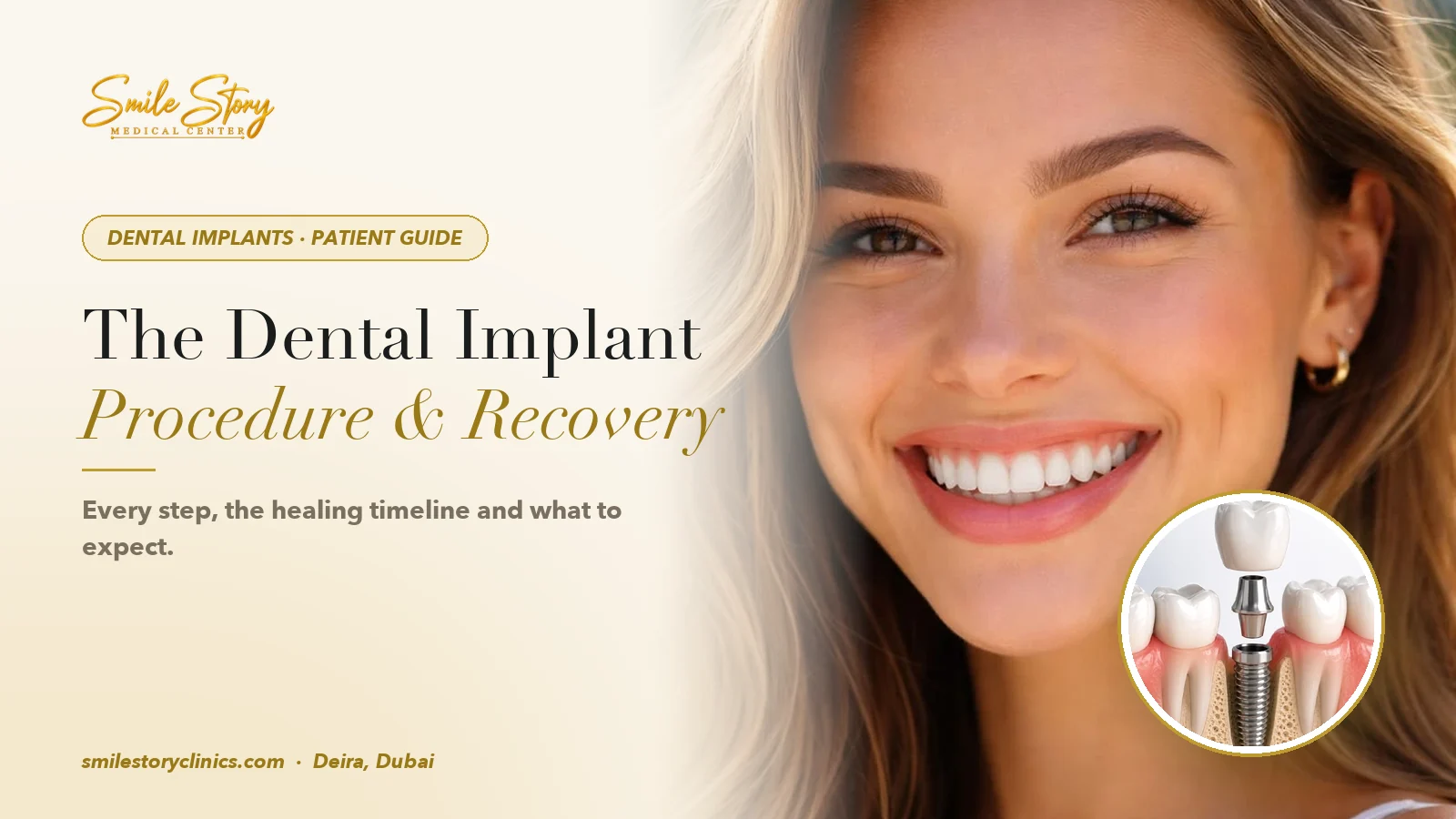
A dental implant is a small medical-grade fixture, usually titanium, placed in the jawbone to replace the root of a missing tooth. Over the following months the bone grows onto its surface in a process called osseointegration. Once the implant is fused, it supports an abutment (a connector) and a custom crown, bridge or denture that looks and works like a natural tooth.
Who is a suitable candidate?
Most adults in good general and oral health can be considered. Your dentist will assess:
- The number and position of missing teeth
- Jawbone volume and density
- Gum health, since active gum disease must be treated first
- Your bite and the condition of neighbouring teeth
- Medical history and medications
- Smoking or nicotine use
- Diabetes and how well it is controlled
- Your ability to keep up hygiene and follow-up visits
Smoking and poorly controlled diabetes are recognised risk factors for implant complications, but neither automatically rules you out. Age on its own is not a barrier either; overall health and bone condition matter more.
The dental implant procedure, step by step
1. Consultation and 3D planning
Treatment starts with an examination and a 3D CBCT scan. The scan shows bone volume, the position of nerves and the sinuses, so the implant can be planned precisely. At Smile Story we use this data for 3D-guided implant surgery.
2. Preparatory treatment, if needed
Some patients need treatment first: gum disease care, the extraction of a failing tooth, or a bone graft or sinus lift where there is not enough bone. These steps add healing time but give the implant a secure foundation.
3. Implant placement
Under local anaesthesia, the implant is placed in the jawbone through a small opening in the gum. Sedation is available for anxious patients and longer procedures. In selected cases an implant can be placed on the same day as an extraction (an immediate implant), but this depends on the bone, the socket and the absence of infection.
4. Healing and osseointegration
Over roughly 3 to 6 months the bone fuses with the implant. A temporary tooth can often be worn during this time so you are not left with a visible gap.
5. Abutment and final crown
Once the implant is stable, the abutment is attached and a custom crown, colour-matched to your teeth, is fixed on top. For several missing teeth, implants can support a bridge, and for a full jaw, an All-on-4 or All-on-6 fixed arch.
How long does a dental implant take?
A straightforward single implant usually takes 3 to 6 months from placement to the final crown, over about 3 to 5 visits. Treatment takes longer when it involves:
- Bone grafting or a sinus lift
- Several missing teeth
- Treatment for gum disease or infection first
- Complex bite issues
“Same-day” or immediate implants mean the implant, and sometimes a temporary tooth, is placed on the day of extraction. The bone still needs time to heal before the final restoration, so it is not a one-visit treatment.
Does getting a dental implant hurt?
The area is fully numbed with local anaesthesia, so most patients feel pressure and vibration rather than pain during surgery. Afterwards, mild soreness, swelling or bruising for a few days is normal and is usually managed with the medication your dentist recommends. If pain or swelling gets worse instead of better, contact your dentist.
Recovery and aftercare
Most people return to normal daily routines the day after surgery. During early healing:
- Take medication exactly as prescribed
- Eat soft foods and avoid chewing on the implant side
- Keep the area clean as instructed, and rinse gently
- Do not smoke, as it slows healing and raises the risk of failure
- Attend every follow-up appointment
Call your dentist if you notice increasing swelling, fever, pus, persistent bleeding or altered sensation.
How long do dental implants last?
Implants are designed as a long-term tooth replacement, but no responsible dentist promises a fixed number of years. Longevity depends on oral hygiene, gum health, smoking, medical conditions, bite forces and regular professional care. An implant cannot decay, but the gum and bone around it can become inflamed (peri-implant disease), so daily cleaning and check-ups matter. Book regular check-ups and professional cleaning.
Risks and limitations
Implant placement is minor oral surgery, so it is not risk-free. Possible complications include infection, the implant not fusing with the bone, gum inflammation, nerve-related altered sensation, sinus problems in the upper jaw and mechanical issues with the crown. Careful planning with 3D imaging and good aftercare reduce these risks, and your dentist should discuss them before treatment.
Common myths about dental implants
| Myth | Fact |
|---|---|
| “An implant is the same as a crown.” | The implant replaces the root; the crown is the visible tooth attached to it. |
| “Anyone who loses a tooth can get an implant straight away.” | Bone, gums, infection and medical history must be assessed first. |
| “Implants never need check-ups.” | They need daily cleaning and regular professional review. |
| “Older adults cannot have implants.” | Age alone is not a barrier; general and bone health matter more. |
| “Implants are completely risk-free.” | No surgery is risk-free. Risks are low with proper planning and aftercare. |
When should you see a dentist about a missing tooth?
Book an assessment if you have a missing or recently extracted tooth, a loose or failing tooth, difficulty chewing, teeth drifting into a gap, or a loose denture or bridge. Earlier assessment keeps more options open before the bone in the gap changes.
Implant treatment at Smile Story is planned by our implant team, including Dr. Nikeeta Sabhachandani, Specialist Periodontist & Implantologist, and Dr. Rishiraj Jaiswal, Specialist Prosthodontist & Implantologist. Your first consultation is free.
Frequently asked questions
How long does the dental implant procedure take?
expand_more
The surgery to place one implant is usually completed in a single appointment, but the full treatment takes about 3 to 6 months because the bone needs time to fuse with the implant before the final crown is fitted.
Does a dental implant hurt?
expand_more
The area is numbed with local anaesthesia, so most patients feel pressure rather than pain. Mild soreness and swelling for a few days afterwards is normal and manageable.
How many visits does a dental implant need?
expand_more
Usually 3 to 5 visits: consultation and 3D scan, implant placement, a healing check, and fitting the abutment and final crown. Extra visits are needed if you need an extraction or bone graft.
Can an implant be placed on the same day as an extraction?
expand_more
In selected cases, yes. An immediate implant depends on healthy bone, the condition of the socket and no active infection. The final crown still comes after healing.
Do I need a bone graft before a dental implant?
expand_more
Only if there is not enough bone to hold the implant securely. A 3D CBCT scan shows whether a graft is needed.
Can smokers or people with diabetes get dental implants?
expand_more
Often, yes, but both are risk factors. Smoking slows healing, and diabetes needs to be well controlled. Your dentist assesses this individually.
What is the recovery time after implant surgery?
expand_more
Most people return to normal activities the next day. Swelling and tenderness usually settle within a few days, while the implant itself fuses with the bone over 3 to 6 months.
How long do dental implants last?
expand_more
Implants are a long-term solution, but how long they last depends on hygiene, gum health, smoking, bite forces and regular check-ups.